How to implement OKRs: from strategic priorities to verifiable results
A practical guide for CEOs and team leaders: how to choose objectives, define key results and establish regular reviews.
Updated
Strategic planning: from choosing priorities to execution
Strategic planning helps a company decide where to go, how to gain an advantage and where to focus resources. Its practical value emerges when strategic priorities shape teams’ work: which projects they choose, which decisions they make and which results they use to assess progress.
This transition is often where a gap appears. The company has a strategy, a budget and dozens of projects, yet leaders give different answers to the question: what exactly needs to change this quarter to bring us closer to our strategic goal?
OKRs help make this connection concrete. A chosen priority becomes a clear objective, measurable key results and coordinated teamwork. Regular reviews show whether planned actions are having the expected effect and where management intervention is needed.
Strategic planning sets the direction and priorities. OKRs help organise their execution and check progress.
Below is a practical model for a first implementation, from defining objectives to closing the cycle. The examples are illustrative; their metrics should be adapted to the company’s data and capabilities.
1. Understand the terminology
OKRs are a system for setting and aligning goals in which an Objective describes the desired change and Key Results verify its achievement. The abbreviation stands for Objectives and Key Results — “objectives and key results”. Working with OKRs involves setting priorities, reviewing progress regularly and revising actions.
Three distinct questions underpin OKRs.
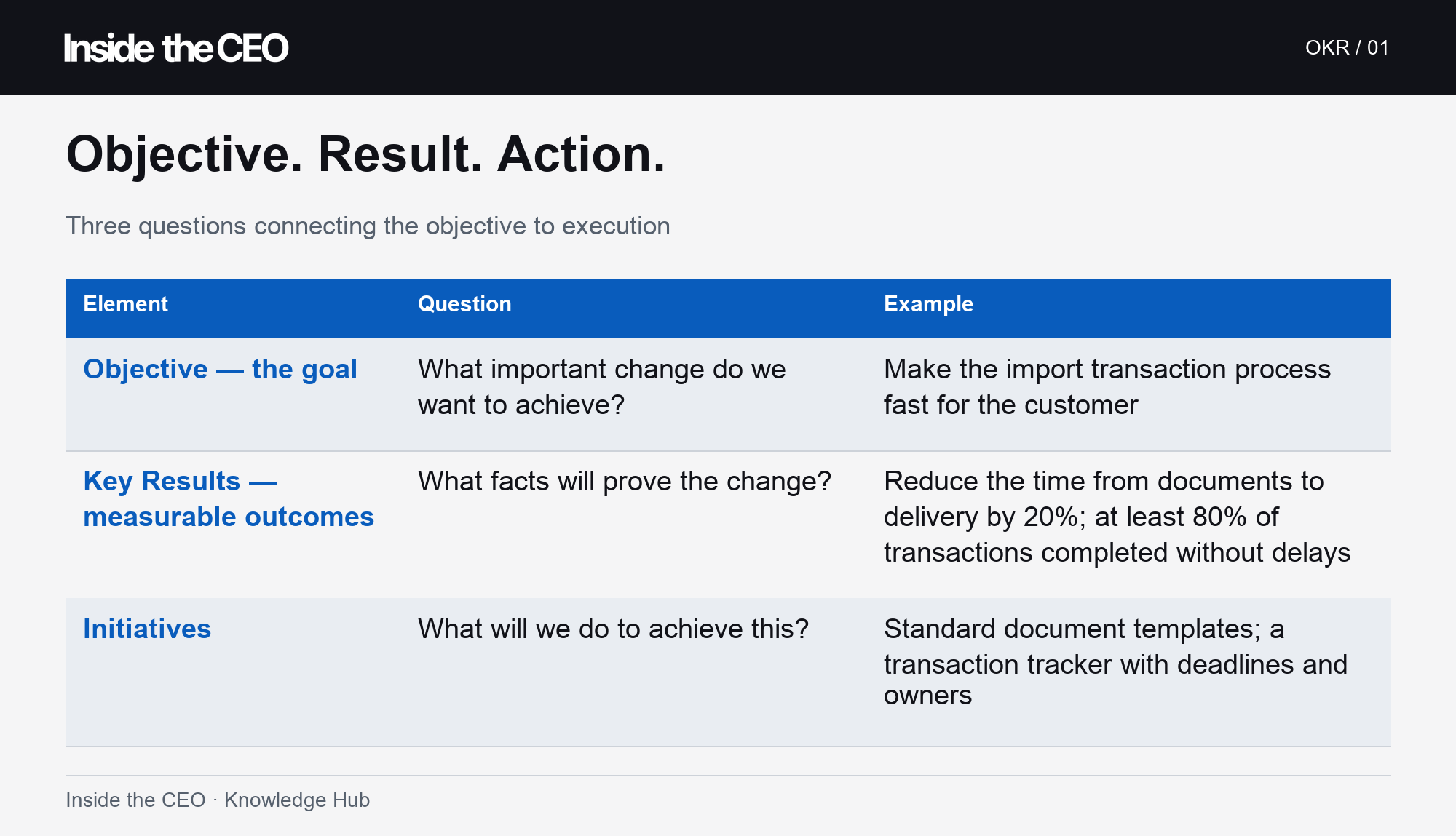
Infographic text
- Objective — the goal
- Question: What important change do we want to achieve?; Example: Make the import transaction process fast for the customer
- Key Results — measurable outcomes
- Question: What facts will prove the change?; Example: Reduce the time from documents to delivery by 20%; at least 80% of transactions completed without delays
- Initiatives
- Question: What will we do to achieve this?; Example: Standard document templates; a transaction tracker with deadlines and owners
The Objective sets the direction. Key Results define success criteria. Initiatives describe the way of working, which the team can change.
Introducing a transaction tracker does not yet prove that customers receive goods faster. Shorter transaction times and fewer delays would demonstrate that.
Felipe Castro suggests viewing projects as hypotheses about achieving an outcome: completing a plan does not in itself guarantee the desired change. The author’s article on outcomes and outputs.
2. Identify the management problem
Start with a brief diagnosis.
- Do leaders identify the company’s main priorities consistently?
- Is it clear how teams’ work affects these priorities?
- Can the outcome be verified beyond the fact that a project has been completed?
- Are disagreements between departments resolved before they derail deadlines?
- Do decisions change when the data shows a lack of progress?
If the problem is a lack of focus, weak coordination or managing a list of tasks, OKRs may be appropriate.
Strategy is a coherent set of choices: for whom the company creates value, how it gains an advantage and where it directs limited resources. If leadership has not yet set this direction, those choices must come first. The OKR format will not decide for the company which market to compete in, which customers to serve or how to win.
Vision → strategy → OKRs → initiatives. Mission and principles provide a shared foundation for decisions.
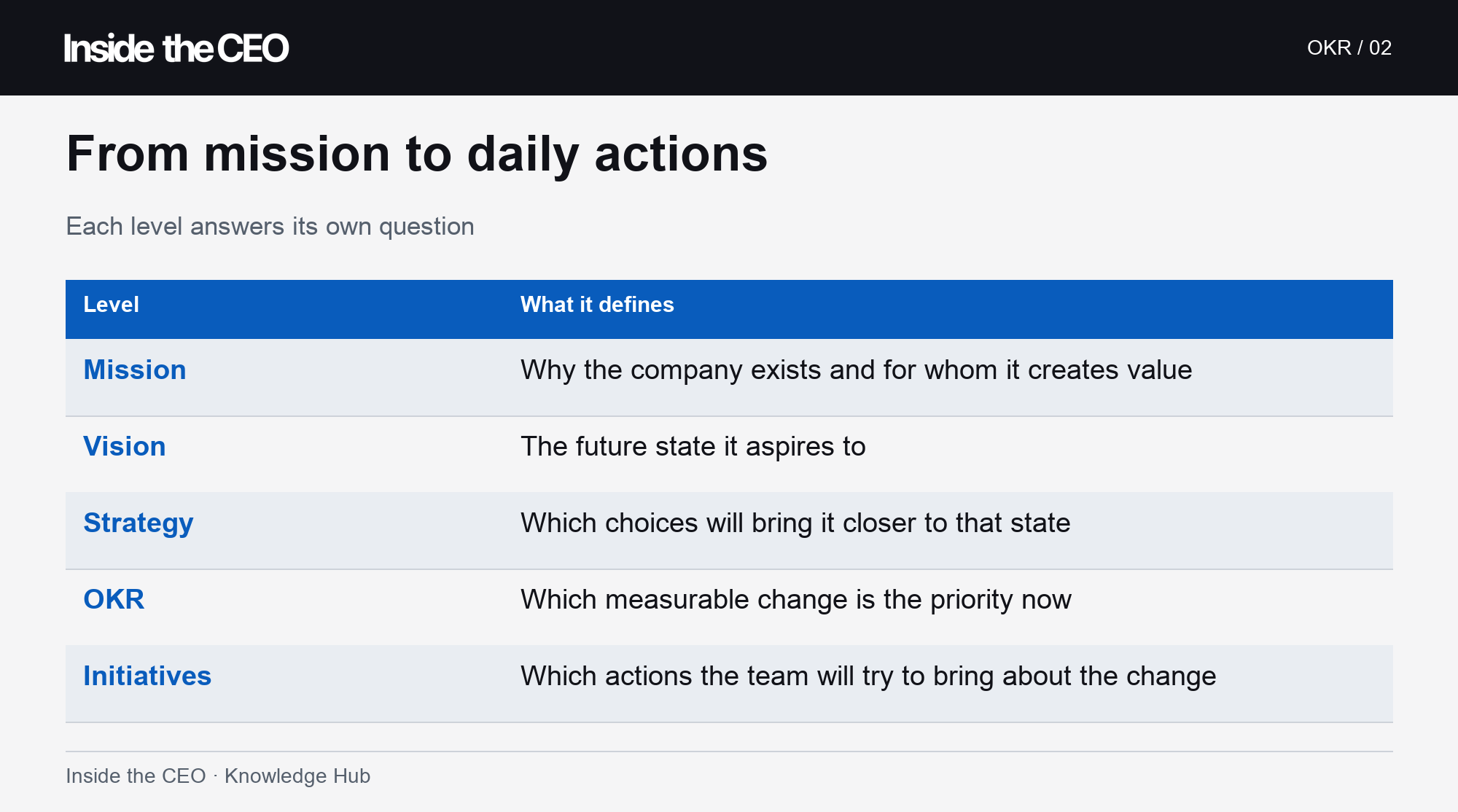
Infographic text
- Mission
- What it defines: Why the company exists and for whom it creates value
- Vision
- What it defines: The future state it aspires to
- Strategy
- What it defines: Which choices will bring it closer to that state
- OKR
- What it defines: Which measurable change is the priority now
- Initiatives
- What it defines: Which actions the team will try to bring about the change
A priority means being willing to forgo some other opportunities. For each potential Objective, write one sentence: “This change matters now because…”. If the answer is unconvincing, the objective is not ready yet.
3. Explain the difference between OKRs and KPIs
A KPI is a key performance indicator that a company uses to assess the state and results of an important process, function or business. The abbreviation stands for Key Performance Indicator. A KPI may have a target value, a threshold or an acceptable range.
A KPI is a metric. An OKR is an “objective + key results” structure and the process of working with it. They can therefore complement each other.
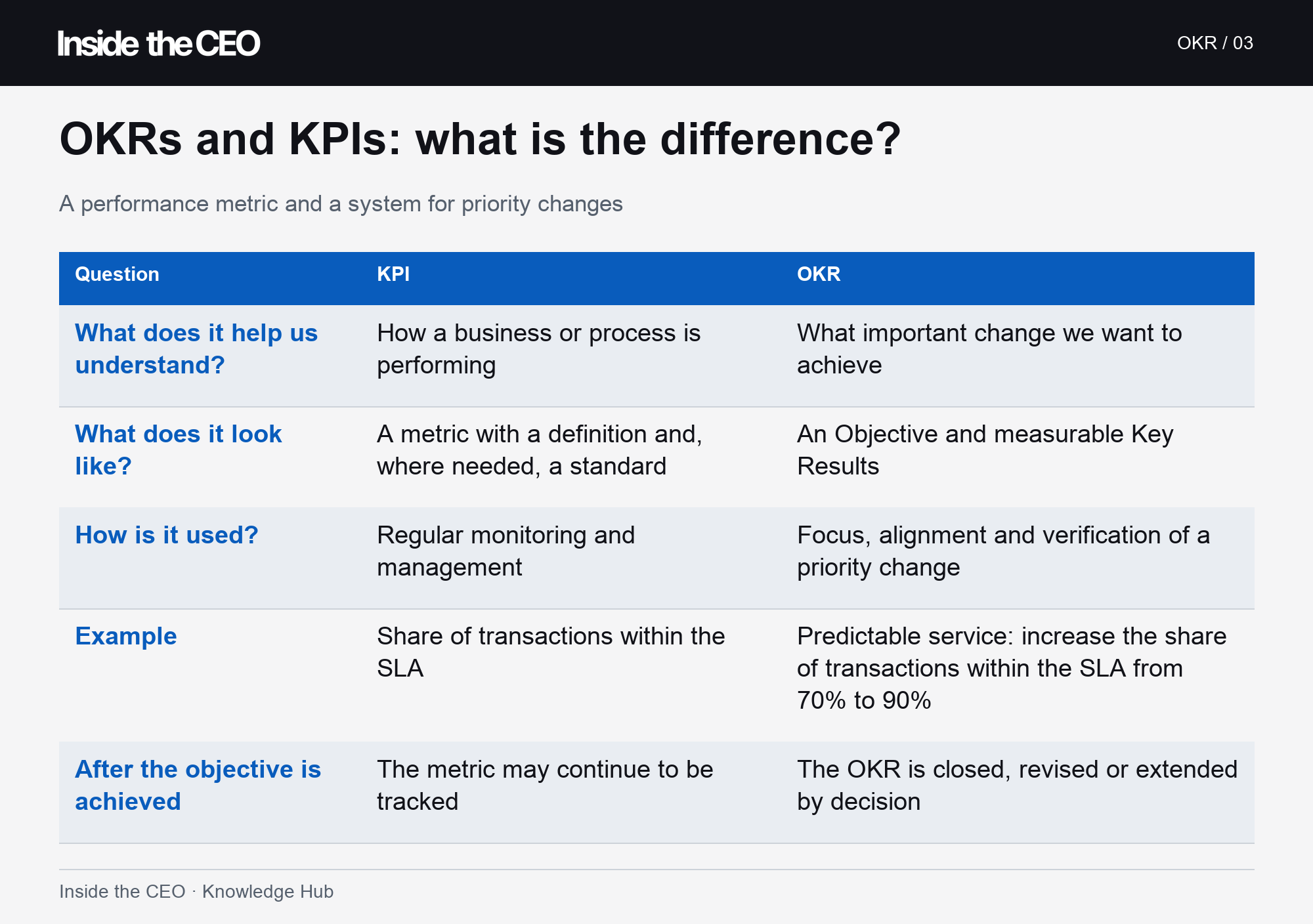
Infographic text
- What does it help us understand?
- KPI: How a business or process is performing; OKR: What important change we want to achieve
- What does it look like?
- KPI: A metric with a definition and, where needed, a standard; OKR: An Objective and measurable Key Results
- How is it used?
- KPI: Regular monitoring and management; OKR: Focus, alignment and verification of a priority change
- Example
- KPI: Share of transactions within the SLA; OKR: Predictable service: increase the share of transactions within the SLA from 70% to 90%
- After the objective is achieved
- KPI: The metric may continue to be tracked; OKR: The OKR is closed, revised or extended by decision
SLA — Service Level Agreement: agreed requirements for the level of service, including timelines and quality. Within a company, they can define how teams work together.
KPIs can be compared to the gauges on a car’s dashboard, and OKRs to important waypoints along the route. We need to understand where we are going while monitoring the health of the system.
How a KPI becomes part of an OKR
A company regularly measures the share of transactions completed in line with the SLA. If leadership decides to substantially improve service predictability, this metric can become a KR: increase the share of these transactions from 70% to 90%.
After the cycle ends, the company can continue tracking the metric as a KPI and choose another improvement priority.
There is no need to turn every job responsibility into an OKR. Paying salaries, supporting customers and meeting mandatory requirements remain essential work.
- Ongoing operations: what needs to work reliably.
- Priority changes: what we will improve through OKRs in this cycle.
- Guardrails: which quality, cost or risk metrics must not deteriorate in pursuit of the objective.
4. Launch a pilot with CEO support
A practical start is two to three weeks of preparation and one quarterly pilot. This is a working scenario, not a mandatory standard.
For the pilot, choose one important business challenge and a few teams that can influence it together. For example, reducing the time from a customer request to completion of the transaction.
Assign responsibilities before defining objectives.
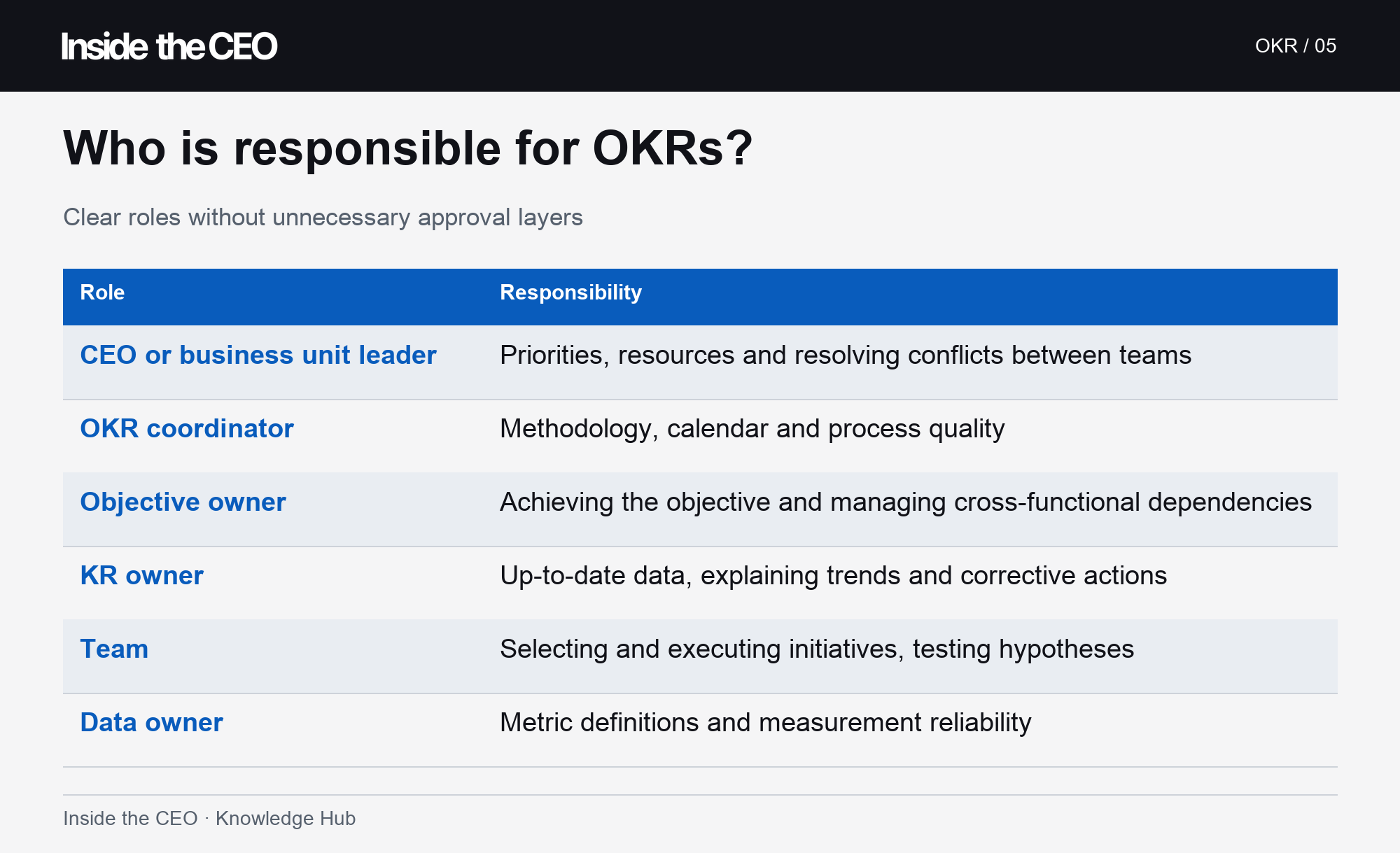
Infographic text
- CEO or business unit leader
- Responsibility: Priorities, resources and resolving conflicts between teams
- OKR coordinator
- Responsibility: Methodology, calendar and process quality
- Objective owner
- Responsibility: Achieving the objective and managing cross-functional dependencies
- KR owner
- Responsibility: Up-to-date data, explaining trends and corrective actions
- Team
- Responsibility: Selecting and executing initiatives, testing hypotheses
- Data owner
- Responsibility: Metric definitions and measurement reliability
In a small company, one person may hold several roles. However, each KR should have one clearly identified person responsible for maintaining it. This does not mean that they single-handedly control every factor affecting the result.
For the first cycle, we recommend limiting a team to one or two Objectives and around three KRs for each. A practical guideline is no more than four KRs per objective. Personal OKRs for every employee at this stage can significantly increase the amount of coordination required.
5. Frame the Objective as an important change
A good objective is easy to understand, linked to strategy and describes a desired state.
Change [what exactly] for [whom] to deliver [value].
Examples of wording:
- Make the import transaction process fast for the customer.
- Give new customers a quick start and a tangible first result.
- Give customers confidence in every request, from submission to fulfilment.
- Help new hires confidently deliver results from their first weeks.
- Ensure teams receive standard IT access quickly and predictably.
Do not try to fit every detail into one sentence. Numerical criteria belong in KRs; deadlines belong in the cycle and result dates.
- Who will be better off if we achieve the objective?
- Why is this change more important than other possible changes right now?
- What can the team realistically influence?
It helps to distinguish the circles of control, influence and concern. A team usually directly controls its own actions, but influences the business outcome alongside other factors. A KR should therefore be within its meaningful influence, and external dependencies should be identified in advance.
6. Frame the KR as evidence of change
Basic structure:
By [date], change [metric for a defined group] from [baseline] to [target value].
By the end of the quarter, reduce the share of requests returned because of document errors from 35% to 15%.
In Who Does What by How Much?, Jeff Gothelf and Josh Seiden suggest viewing outcomes through people’s behaviour: who will do what and by how much differently. For internal teams, these users may be colleagues: managers, recruiters, finance staff and support staff. Gothelf’s explanation of customers inside and outside the company.
Distinguish Input, Output and Outcome
Including a number does not automatically make a statement a good KR.
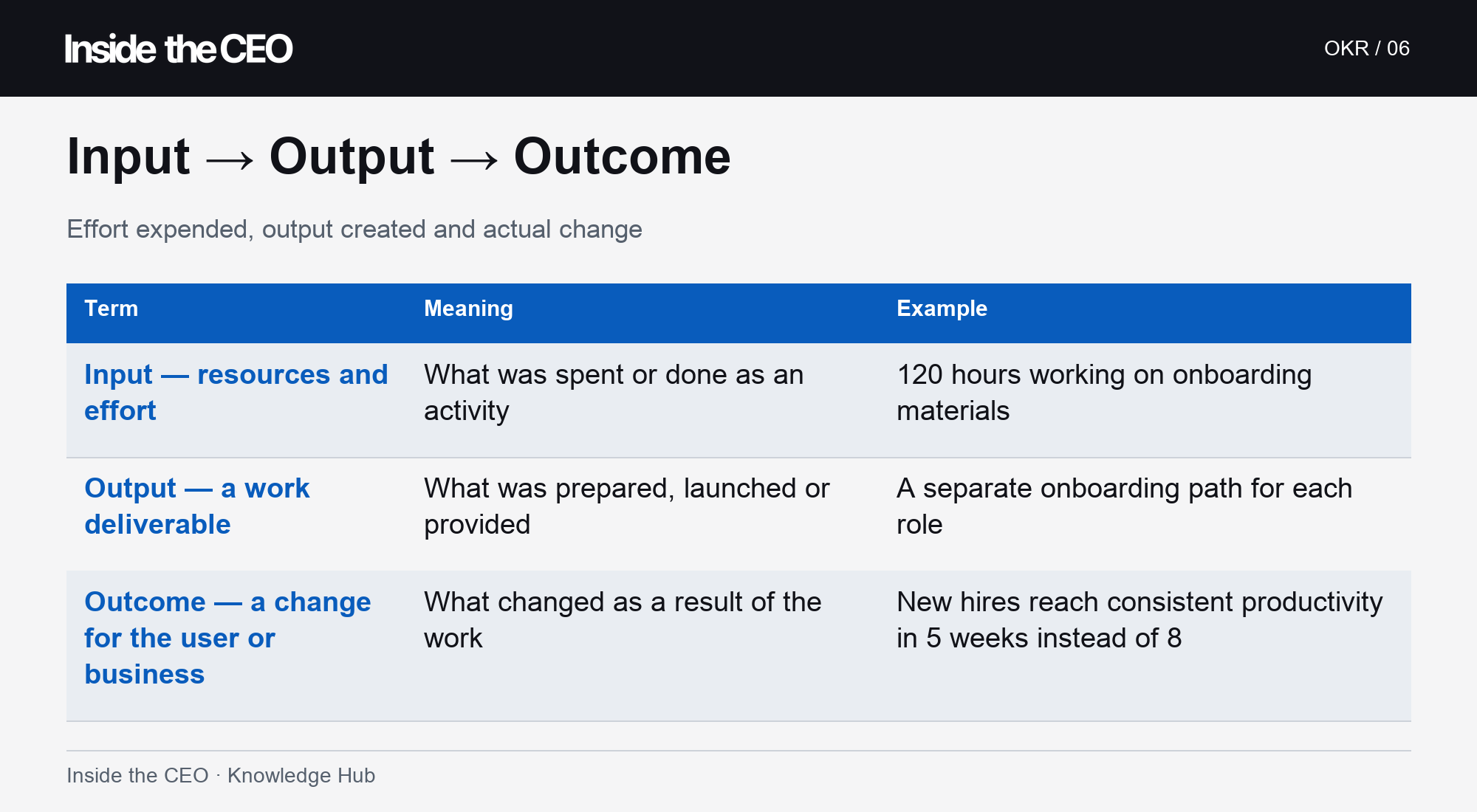
Infographic text
- Input — resources and effort
- Meaning: What was spent or done as an activity; Example: 120 hours working on onboarding materials
- Output — a work deliverable
- Meaning: What was prepared, launched or provided; Example: A separate onboarding path for each role
- Outcome — a change for the user or business
- Meaning: What changed as a result of the work; Example: New hires reach consistent productivity in 5 weeks instead of 8
200 hours of code optimisation show the effort expended; reducing the application’s loading time by two seconds already describes a change in how the product works. A complete KR still needs a baseline, measurement conditions and a deadline.
To move from a task to an outcome, ask:
- Why are we doing this?
- What customer or colleague problem are we solving?
- What behaviour or metric should change?
- How will we know that the change creates value?
Not every intermediate deliverable needs to be removed from the plan. Launching a system, completing research or creating a document may be necessary stages. What matters is not automatically presenting them as proof that a business objective has been achieved.
KR quality check
- Is there a reliable baseline?
- Are the metric and measurement group clearly defined?
- Is the deadline clear?
- Is the data source accessible?
- Can the team meaningfully influence the outcome?
- Could the KR be achieved in a way that harms the business?
- Does the set of KRs prove that the Objective has been achieved?
If all KRs have been achieved but the customer or business has not received the expected value, the criteria were insufficient. This is precisely the check Google recommends in its OKR Playbook.
7. Agree on what success means
Label the type of OKR before work begins.
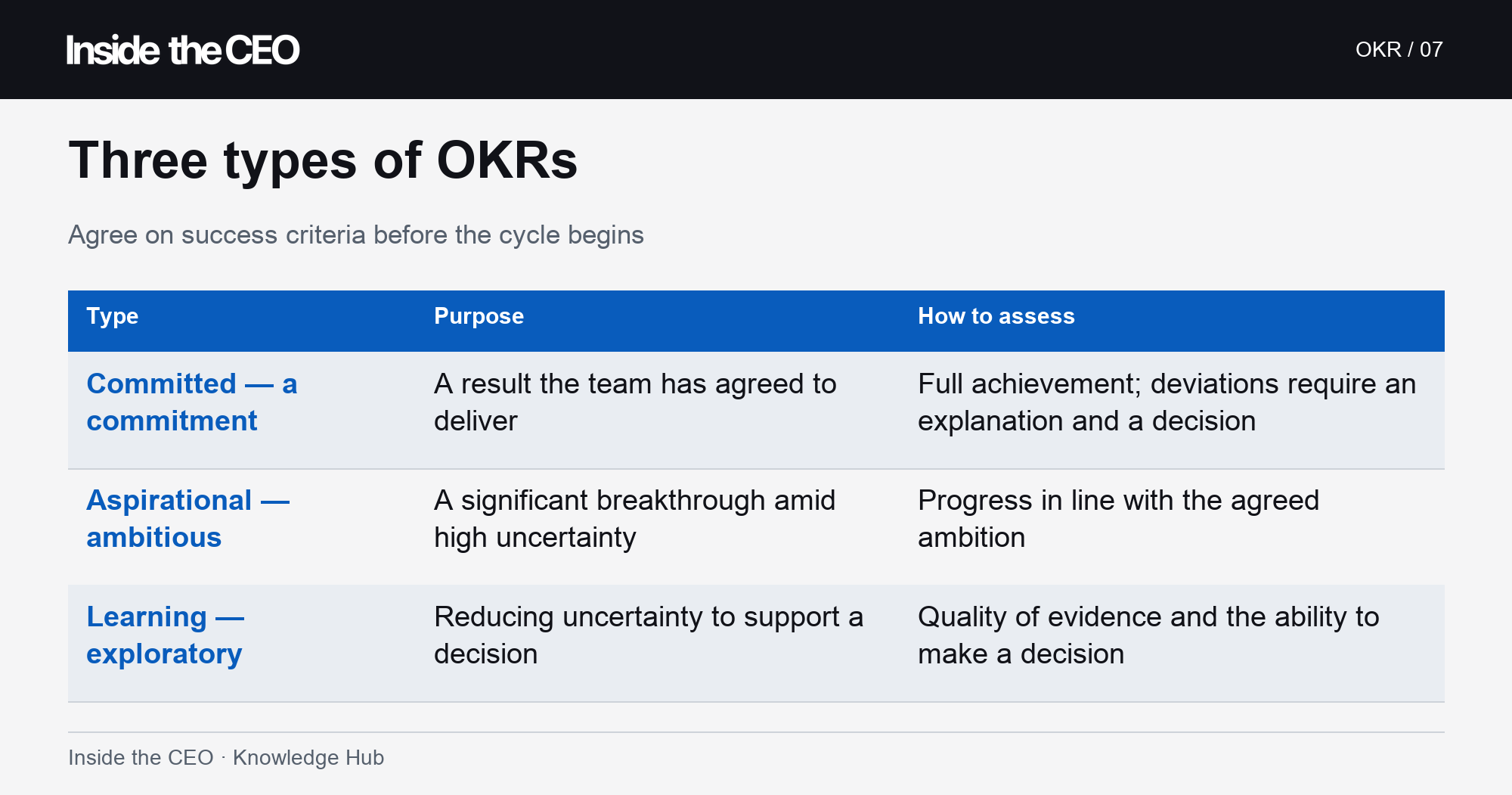
Infographic text
- Committed — a commitment
- Purpose: A result the team has agreed to deliver; How to assess: Full achievement; deviations require an explanation and a decision
- Aspirational — ambitious
- Purpose: A significant breakthrough amid high uncertainty; How to assess: Progress in line with the agreed ambition
- Learning — exploratory
- Purpose: Reducing uncertainty to support a decision; How to assess: Quality of evidence and the ability to make a decision
70% is not a universal standard of success. In Google’s practice, the expected average score of 0.7 applies to aspirational OKRs. For committed OKRs, 1.0 is expected. These are different agreements. Explanation of OKR types.
For learning objectives, confirming a hypothesis should not be the only way to “achieve” an OKR. A well-supported rejection can protect the company from a poor decision. What Matters article on learning OKRs.
For example, a team is testing whether entering a new segment makes sense. At the outset, it agrees which assumptions are critical, how it will test them and what evidence is needed for a decision to “invest”, “refine” or “stop”. The number of interviews alone does not enable that decision.
8. Align team contributions and resources
Vertical alignment answers the question: how does this objective help the company? Horizontal alignment: how do teams help each other, and where might conflicts or duplication arise?
Cascading — from the top down. A corporate KR becomes the basis for a team objective. For example, a priority to grow CRM solution sales translates into a corresponding sales department objective.
Laddering — alignment from the bottom up. The team proposes its own objective and explains how it will support the company’s result. For example, building a strong sales team may contribute to growth in CRM solution sales.
In both cases, a clear rationale for the contribution is needed. A link between two cards in a system does not in itself prove that the team objective supports the corporate one.
If a company wants to speed up import transaction fulfilment:
- sales can improve the completeness of information handed over after an agreement with the customer;
- finance and legal teams can reduce repeated approvals;
- the operations team can reduce delays when handing the transaction over to the next stage.
Before approval, hold a joint alignment discussion:
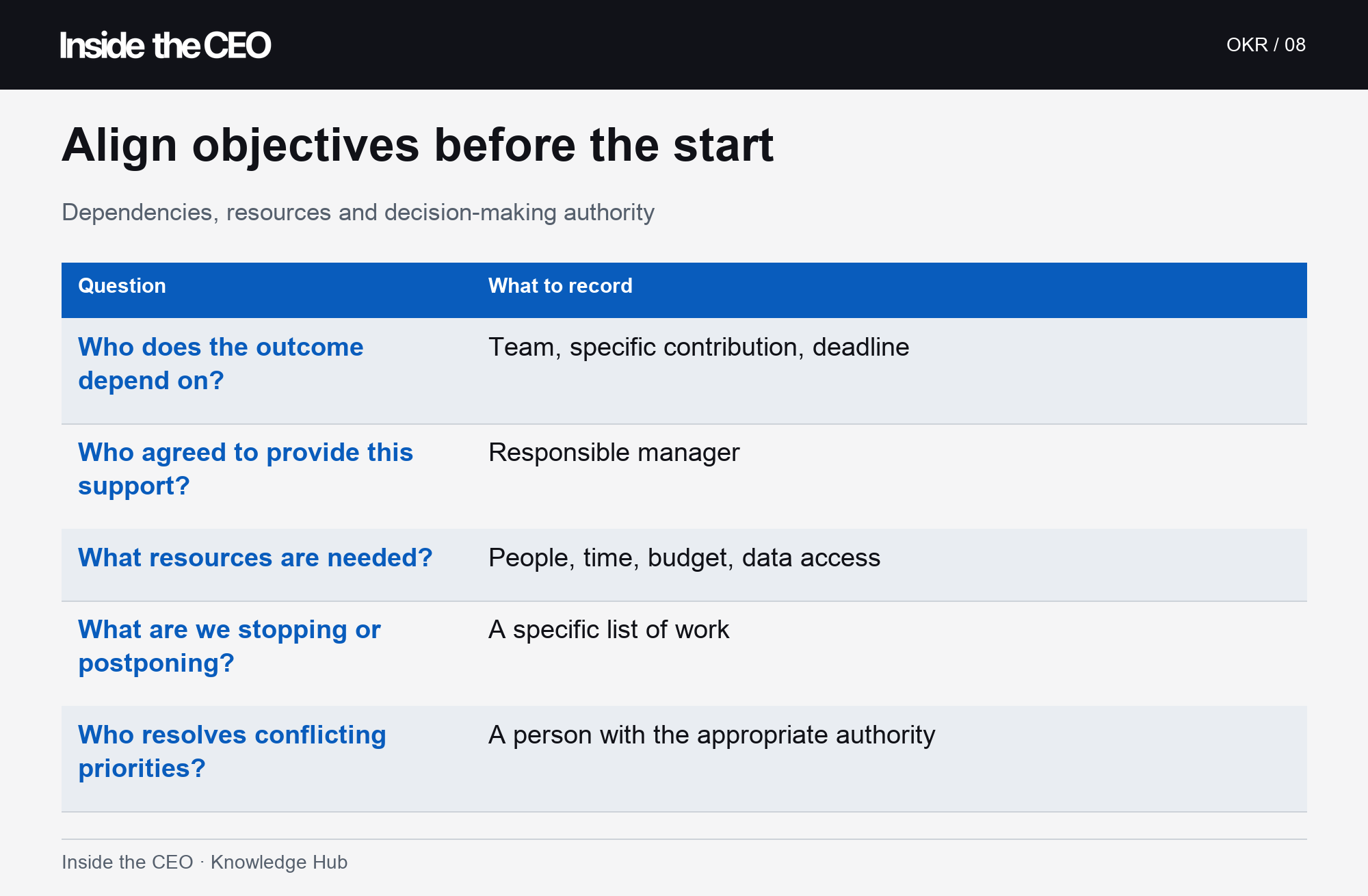
Infographic text
- Who does the outcome depend on?
- What to record: Team, specific contribution, deadline
- Who agreed to provide this support?
- What to record: Responsible manager
- What resources are needed?
- What to record: People, time, budget, data access
- What are we stopping or postponing?
- What to record: A specific list of work
- Who resolves conflicting priorities?
- What to record: A person with the appropriate authority
A particularly important question: what work are we giving up to achieve this OKR? If a priority has been added without reviewing the workload, the team has been given an additional expectation without the resources to meet it.
9. Build a simple review cycle
“Goals are good for setting a direction, but systems are best for making progress.”
James Clear, Atomic Habits, Chapter 1. Editorial translation in the Ukrainian edition. Excerpt from the book on the author’s website.
For OKRs, this idea has a concrete management meaning: a review calendar, accessible data and a habit of making decisions following discussion are needed. Weekly metric updates become useful when the team chooses its next step and the leader removes obstacles. Without these actions, even a well-worded objective remains a written statement. The quote draws attention to recurring practices that support strategy execution.
In her materials accompanying Radical Focus, Christina Wodtke also emphasises the importance of regularly returning to objectives: discussing progress, confidence and next steps. The Art of the OKR, Redux.
For the first cycle, you can use the following rhythm:
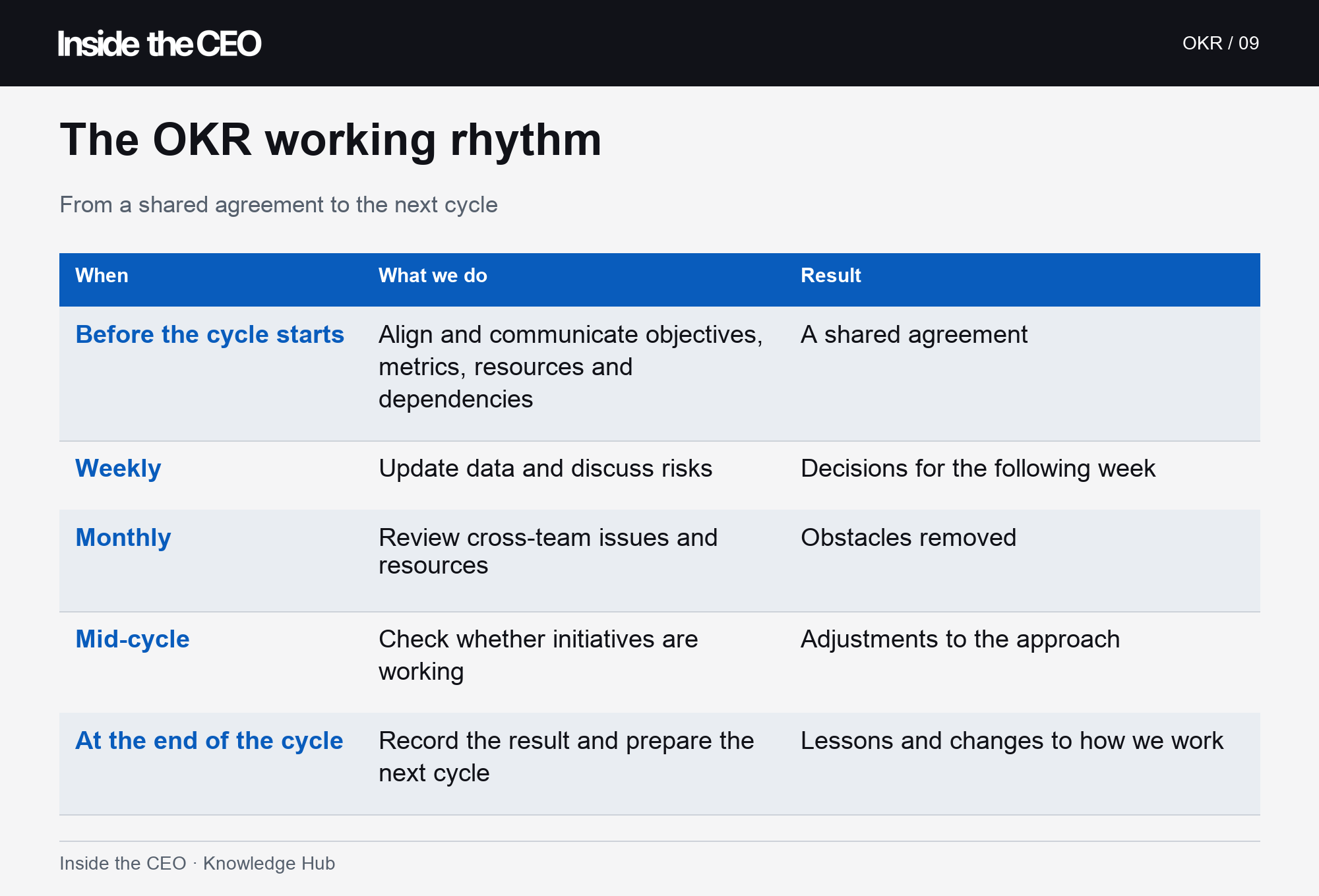
Infographic text
- Before the cycle starts
- What we do: Align and communicate objectives, metrics, resources and dependencies; Result: A shared agreement
- Weekly
- What we do: Update data and discuss risks; Result: Decisions for the following week
- Monthly
- What we do: Review cross-team issues and resources; Result: Obstacles removed
- Mid-cycle
- What we do: Check whether initiatives are working; Result: Adjustments to the approach
- At the end of the cycle
- What we do: Record the result and prepare the next cycle; Result: Lessons and changes to how we work
A weekly 20–30-minute meeting
Data is updated before the meeting. During it, the team answers five questions:
- What has changed in the metrics?
- Will we reach the objective by the deadline under the current plan?
- What is getting in the way?
- What action or hypothesis are we changing?
- What decision do we need from leadership?
For every risk, keep a record of the next action, its owner and the review date.
A weekly check-in differs from the final assessment: its purpose is to help the team influence the future outcome. What Matters on the difference between checking in and scoring.
A common mistake is that OKRs exist only in OKR meetings. To avoid this, use them when planning the week, selecting projects and reviewing priorities.
10. Separate actuals from forecasts
- Current value: what the data shows.
- Progress: how much of the planned change has been achieved.
- Forecast: whether we will finish by the end of the cycle.
For a linear metric that needs to increase:
Progress = (current value − baseline) / (target − baseline).
For a metric that needs to decrease:
Progress = (baseline − current value) / (baseline − target).
Take the KR: increase the share of transactions within the SLA from 70% to 90%. If the current value is 80%, half of the planned improvement has been achieved:
(80 − 70) / (90 − 70) = 0.5, or 50%.
This is an illustrative calculation. The formula applies to this type of metric; it is not a universal way to score every KR. Milestones, threshold conditions and research need their own acceptance criteria.
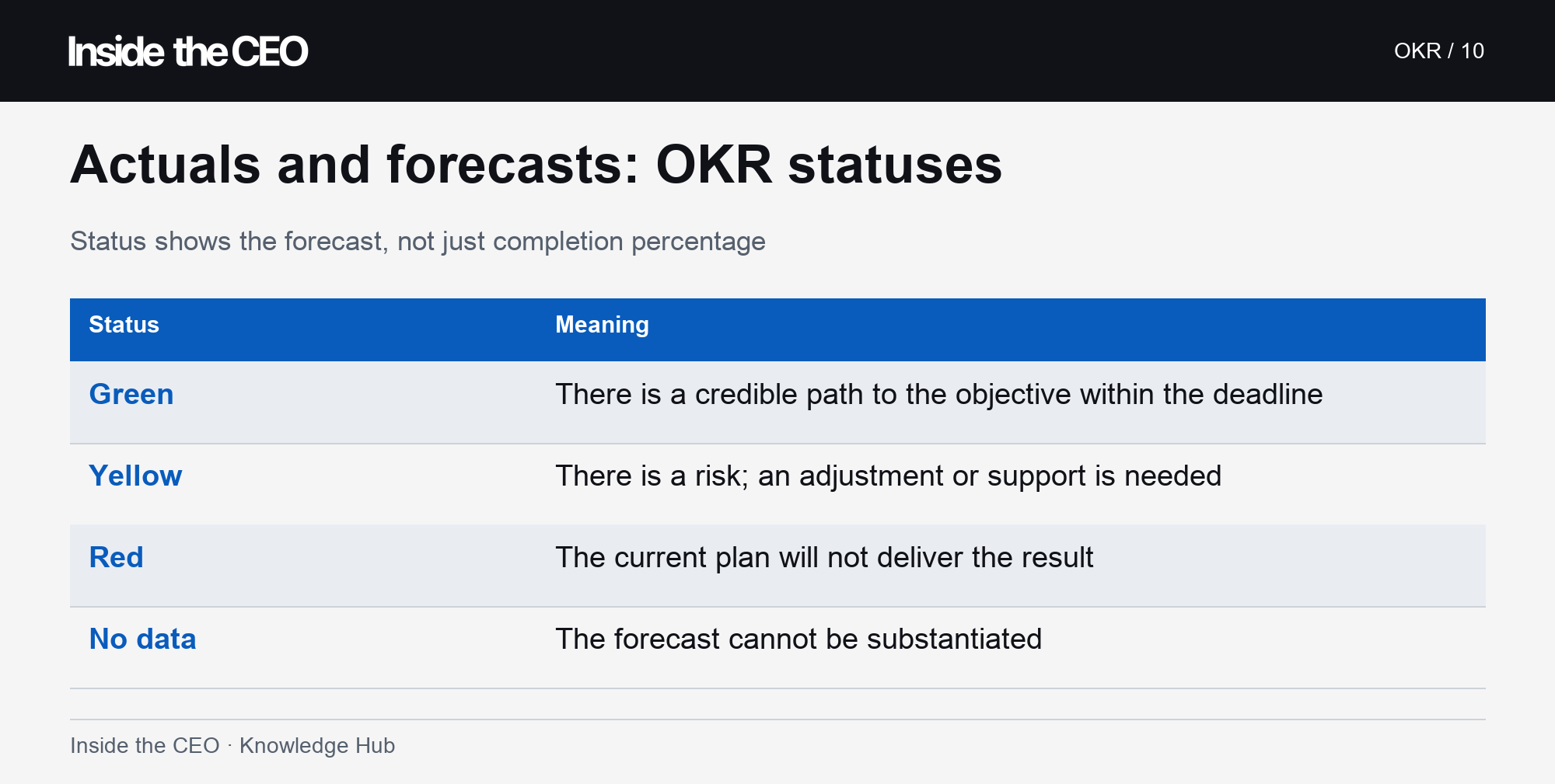
Infographic text
- Green
- Meaning: There is a credible path to the objective within the deadline
- Yellow
- Meaning: There is a risk; an adjustment or support is needed
- Red
- Meaning: The current plan will not deliver the result
- No data
- Meaning: The forecast cannot be substantiated
High progress does not guarantee green status. A team may have achieved 80% of the change but hit an obstacle it cannot remove in time.
For KRs with delayed data, add leading indicators. For example, the actual delivery time becomes known after a transaction is completed, while a backlog of stalled requests becomes visible sooner. An early signal helps with management, but does not replace final evidence.
11. Define the response to deviations
Suggested rules for the pilot:
- No data: the KR owner agrees on how and when measurement will be restored. An unknown value is not marked green.
- Yellow status: the team defines a specific corrective action.
- Red committed KR: the owner immediately presents the manager with options for a decision: changes to resources, priorities or the execution approach.
- Two check-ins without progress: the team checks whether the initiative is working and whether the metric can respond quickly enough.
- A guardrail metric has been breached: the team revises how it pursues the objective, even if the main metric is improving.
The response to a red status should support a decision. Asking “what should we change?” is more useful than demanding that the report turn green.
Can OKRs change during the cycle?
Initiatives should be revised when new data emerges. Changing the objective itself or its target value requires a separate decision.
Grounds may include a significant strategy change, the loss of a key prerequisite or a discovered measurement error. Falling behind is not, on its own, sufficient reason to lower the target.
Keep the previous version, the reason for the change, the date and the person who approved it. At the end of the cycle, both the original agreement and what happened afterwards should be visible.
12. OKR examples for different teams
The following examples are illustrative. Before using them, agree on deadlines, baselines and measurement rules.
Example 1. A faster import transaction
Objective: make the import transaction process fast for the customer.
Key Results:
- Reduce the time from receiving documents to delivering goods by 20%.
- Ensure at least 80% of transactions proceed without delays.
Initiatives:
- Develop standard document templates for the customer.
- Introduce a single transaction tracker with deadlines and owners.
- Identify common causes of delays and standard ways to resolve them.
- Agree on rules for handing a transaction over to the next stage.
What to clarify before launch: the baseline period; whether mean or median time is measured; which documents start the clock; what counts as delivery and a delay; which transactions are included in the calculation.
Unfinished transactions must also be tracked: if only those closed quickly are counted, the metric may improve on paper while complex transactions remain stalled.
Example 2. Predictable service
Objective: build a fast, transparent and predictable service function across the entire value chain.
Key Results:
- Increase the share of transactions completed in line with the SLA from 70% to 90%.
- Ensure 100% of transactions have an owner and an up-to-date status.
The first KR describes the service outcome. The second provides necessary process transparency, but does not in itself prove an improved customer experience. Whether it makes sense as a separate KR depends on the company’s problem; it may also be a mandatory standard for managing transactions.
What to clarify: the content of the SLA, the rule for keeping status current and the source of verification. Simply filling in the “owner” field does not mean the transaction was completed on time.
Example 3. Reliable equipment servicing for business
A company rents out equipment and arranges its servicing. Customers need to understand what is happening with a request and when it will be fulfilled.
Objective: give customers confidence in every request, from submission to fulfilment.
Key Results:
- At least 85 out of 100 requests are fulfilled no later than the date promised to the customer.
- Customers rate the transparency of request status at least 4.5 out of 5.
Initiatives: display status changes in the customer portal and send automatic notifications; review delayed requests weekly with the service and customer teams.
What to clarify: the assessment period, rules for recording the promised date, survey methodology and minimum sufficient number of responses. The date must not be changed retroactively merely to meet the metric.
Example 4. Helping new hires deliver results sooner
Objective: help new hires confidently deliver results from their first weeks.
Key Results:
- New hires reach consistent productivity in five weeks instead of eight, as assessed by managers.
- By the tenth working day, nine out of ten new hires independently complete their first real task.
Creating an onboarding path for each role is one possible way to achieve these results. The 120 hours spent updating materials show the team’s effort.
What to clarify: which roles are being compared, what consistent productivity means and which common criteria managers use to assess it. An agreed quality standard is also needed for the first real task.
Example 5. Employee engagement and retention
Objective: improve employee engagement.
Key Results:
- Increase eNPS from 20 to 30 points.
- Reduce the voluntary turnover rate from 15% to 10%.
Initiatives: conduct 360° feedback within teams; remove two of the five main blockers.
eNPS measures willingness to recommend an employer and does not cover every aspect of engagement. This index is expressed in points. Qualtrics explanation of the metric.
Before launch, agree on comparable periods for staff turnover, the definition of voluntary departure and the survey methodology. A quarterly figure must not be compared with an annual one without explanation.
13. Close the cycle with results and lessons
The final review consists of two parts.
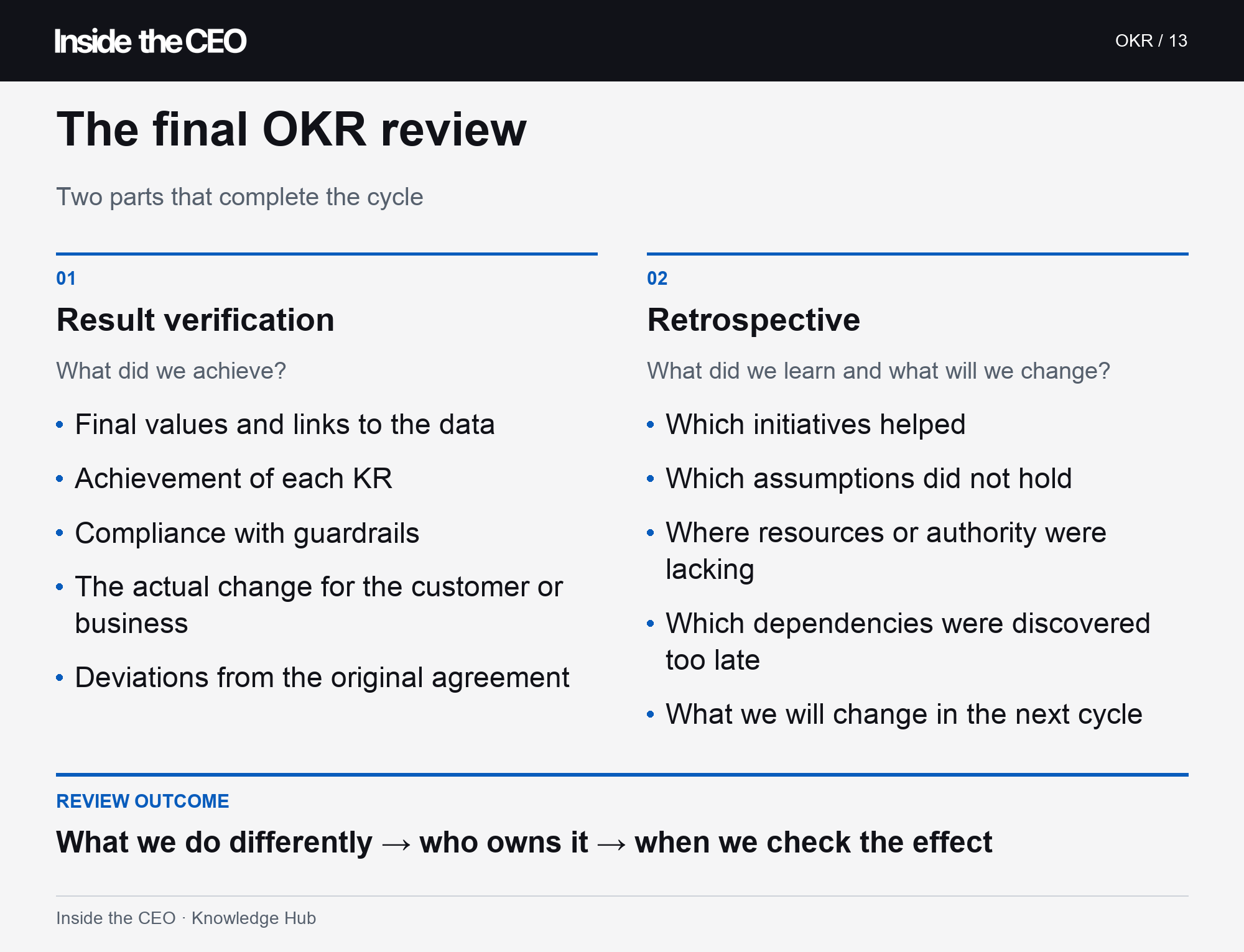
Infographic text
Result verification:
- final values and links to the data;
- achievement of each KR;
- compliance with guardrails;
- the actual change for the customer or business;
- deviations from the original agreement.
Retrospective:
- which initiatives helped;
- which assumptions did not hold;
- where resources or authority were lacking;
- which dependencies were discovered too late;
- what we will change in the next cycle.
An unprepared meeting, shifting blame and lessons without follow-up actions deprive a retrospective of value. It should result in specific changes: what we will do differently, who is responsible and when we will check the effect.
Do not let an average score hide a critical failure. If speed increased but quality fell below the agreed threshold, a separate management explanation is needed.
An unachieved OKR should not be carried forward automatically either. First check whether it remains a priority and what exactly will change in the approach.
14. Do not turn OKRs into a bonus formula
A direct “achieve the OKR, receive a bonus” scheme creates an incentive to set low targets and avoid risk.
A practical approach for a first implementation is to separate OKR assessment from a mechanical calculation of compensation. Results can inform a conversation about an individual’s contribution, alongside their responsibilities, quality of work, collaboration and context.
The What Matters team also recommends this distinction: an unachieved team KR does not automatically mean that an individual employee’s professional performance is poor. OKRs and compensation.
15. Use a single OKR card
For the pilot, a shared spreadsheet or page with the following fields is sufficient:
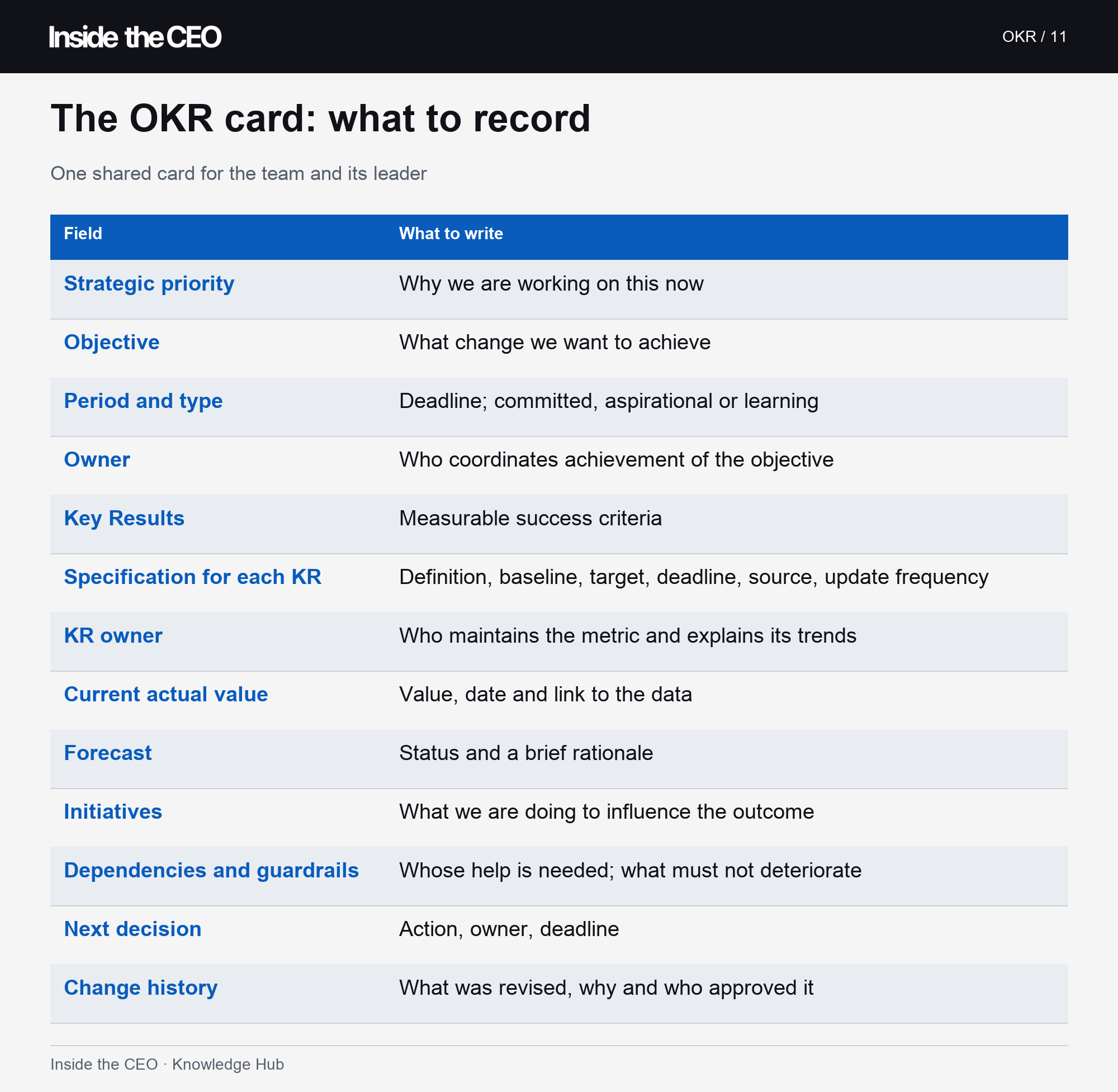
Infographic text
- Strategic priority
- What to write: Why we are working on this now
- Objective
- What to write: What change we want to achieve
- Period and type
- What to write: Deadline; committed, aspirational or learning
- Owner
- What to write: Who coordinates achievement of the objective
- Key Results
- What to write: Measurable success criteria
- Specification for each KR
- What to write: Definition, baseline, target, deadline, source, update frequency
- KR owner
- What to write: Who maintains the metric and explains its trends
- Current actual value
- What to write: Value, date and link to the data
- Forecast
- What to write: Status and a brief rationale
- Initiatives
- What to write: What we are doing to influence the outcome
- Dependencies and guardrails
- What to write: Whose help is needed; what must not deteriorate
- Next decision
- What to write: Action, owner, deadline
- Change history
- What to write: What was revised, why and who approved it
At the start, establishing a shared understanding and regular use of this card matters more than selecting a dedicated platform.
Launch readiness check
The first cycle can begin when every question has a specific answer:
- What business problem does the pilot address?
- Which leader supports it and makes decisions about resources?
- Why were these particular objectives chosen?
- What data will prove the result?
- Who is responsible for each KR?
- Have cross-team dependencies been agreed?
- What work has been postponed to make room for the priority?
- When do check-ins take place?
- What do we do when the status is red?
- How will we assess the result at the end of the cycle?
Signs that implementation needs adjustment
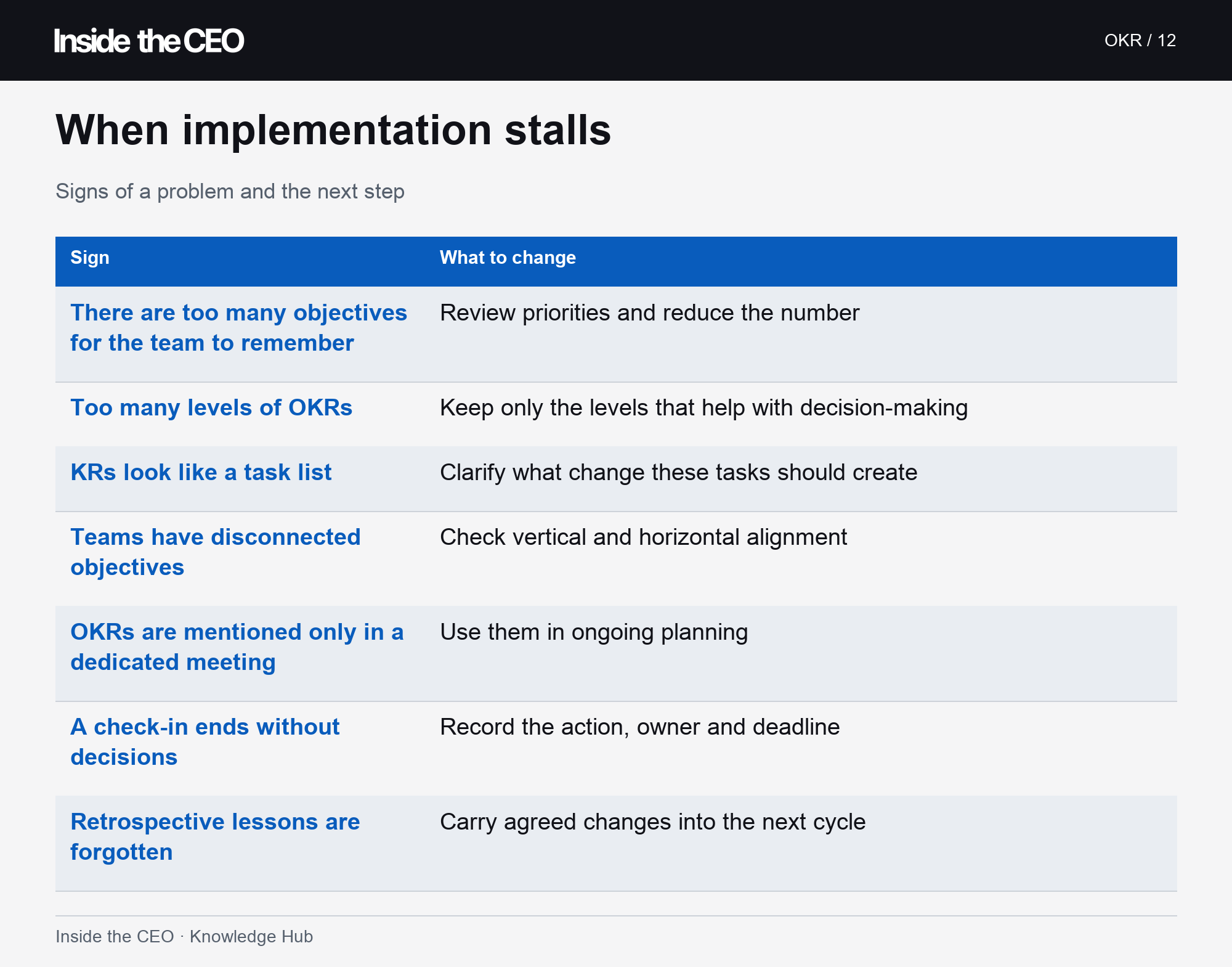
Infographic text
- There are too many objectives for the team to remember
- What to change: Review priorities and reduce the number
- Too many levels of OKRs
- What to change: Keep only the levels that help with decision-making
- KRs look like a task list
- What to change: Clarify what change these tasks should create
- Teams have disconnected objectives
- What to change: Check vertical and horizontal alignment
- OKRs are mentioned only in a dedicated meeting
- What to change: Use them in ongoing planning
- A check-in ends without decisions
- What to change: Record the action, owner and deadline
- Retrospective lessons are forgotten
- What to change: Carry agreed changes into the next cycle
After the pilot, the decision to scale should be based on practical signs: teams understand priorities better, see problems earlier, change ineffective initiatives and can substantiate results with data. Simply filling in every card does not prove this.
How OKRs support strategic planning
OKRs help maintain the connection between strategic planning and day-to-day management. The company identifies a priority change, teams agree on their contribution, and leaders regularly check whether their decisions are bringing them closer to the expected result.
This connection works both ways. Strategy guides teams’ work, while OKR results inform the next strategic planning cycle: which assumptions held, where capabilities are lacking and which priorities need to be reviewed.
Implementation quality should therefore be assessed through changes in management: whether priorities have become clearer, whether they have received the resources they need, whether cross-team issues are resolved faster and whether the company can substantiate progress with data.
OKRs become a useful part of strategic planning when they help select actions, verify their effect and use the lessons learned to inform subsequent decisions.
Books and further reading
Authors’ articles and practical explanations
- Jeff Gothelf, Josh Seiden — Who Does What by How Much? (2024). Outcomes through customer value and behaviour. About the book on the author’s website.
- Felipe Castro — An OKR should measure the outcome, not the work (2024). Moving from reporting work to assessing its effect. The author’s article.
- What Matters — OKRs and compensation (2026). How to separate team objectives and employee assessment. Article.
Classic works and context for the approach
- John Doerr — Measure What Matters (2018). Ambitious objectives, alignment and management conversations. Official book page.
- Christina Wodtke — Radical Focus. Team focus and a regular rhythm for working with objectives. The author’s article accompanying the book (2020).
- James Clear — Atomic Habits (2018). Building a regular practice. Excerpt from Chapter 1 used for the quote.
- Google — OKR Playbook. A historical example of a corporate approach to wording and different types of objectives. Primary source.
The authors’ approaches differ in their details: the level of ambition, the number of objectives and the use of different OKR types. A company needs to deliberately choose a coherent model and explain it to teams before the cycle begins.