Cultural debt: why new skills do not change a company’s old rules
The company teaches people to work differently but rewards old behaviour. How to recognise cultural debt in decisions, authority and incentives — and start paying it down.


The company invests in training, launches AI projects and encourages the team to experiment. But decisions still wait for the CEO’s approval, a failed attempt can cost someone their bonus, and uncomfortable questions are better kept to oneself. People already know how to work differently. The organisation still rewards them for old behaviour. The concept of cultural debt helps explain this gap.
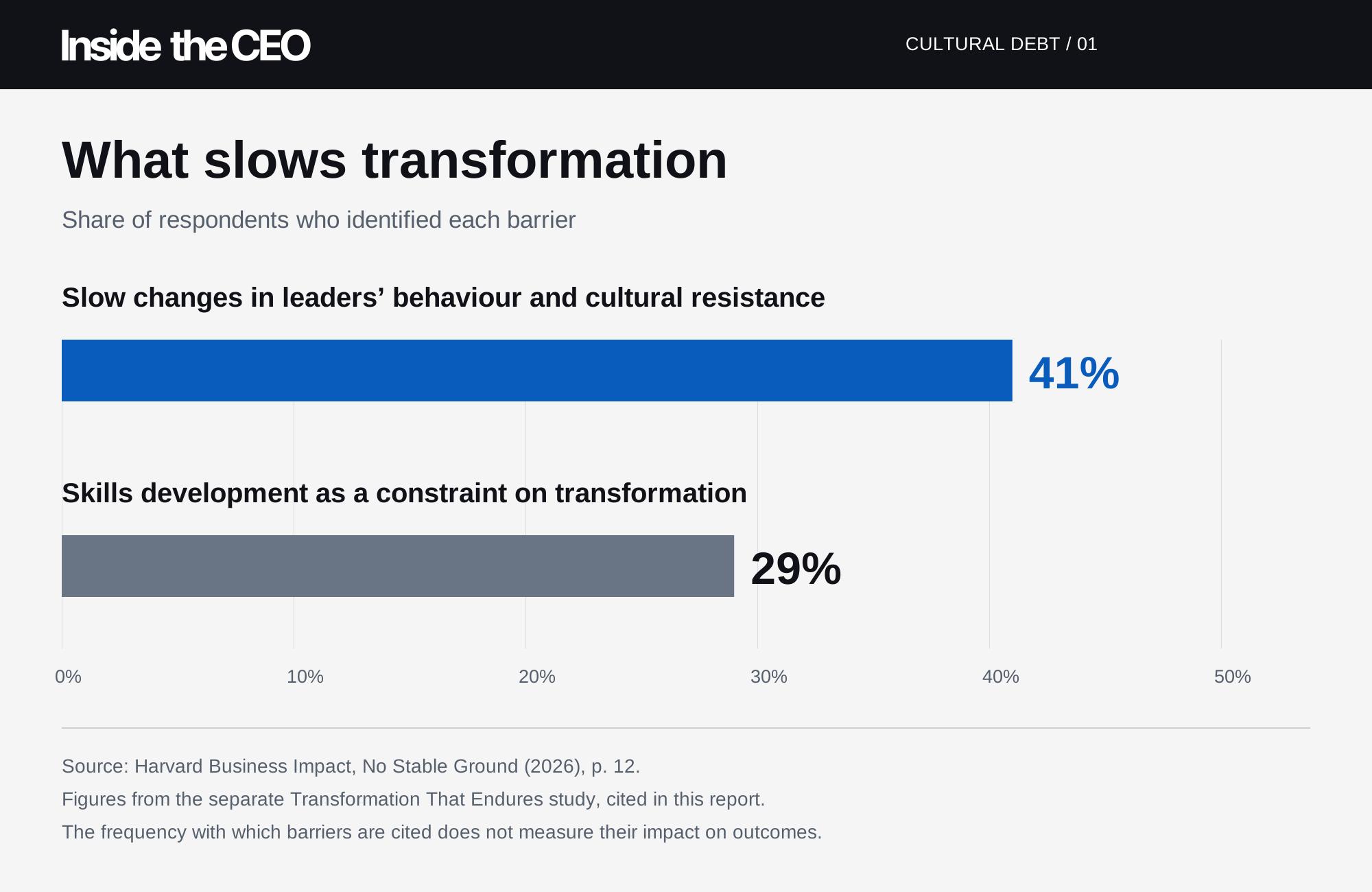
Harvard Business Impact’s “No Stable Ground” report, based on the Global Leadership Study 2026, contains a revealing comparison. Citing a separate study of transformation, the authors note that 41% of respondents identified slow changes in leaders’ behaviour and cultural resistance as a barrier, while 29% cited skills development as a constraint on transformation progress.
Respondents see management behaviour and cultural resistance as reasons why change stalls.
What a company puts off until later
The report’s authors connect cultural debt with unexamined assumptions that, alongside technical debt, can limit the returns from transformation. These are habits, expectations and rules formed in a different environment that have outlived the circumstances in which they were useful.
A hypothetical example makes the logic of debt clear. The founder of a young company personally approves every significant expense. At the outset, this provides control and helps preserve cash. Eventually, directors arrive who are accountable for results but lack sufficient authority. The CEO gradually becomes a bottleneck for the entire organisation.
A once-useful rule now creates recurring costs: longer approvals, repeated discussions, missed opportunities and leaders’ time. These consequences can be thought of as interest on cultural debt. This is a management metaphor, not an accounting measure, but it illustrates how every action in a system is connected, and how something that seems to work at the beginning can later become a source of weak accountability in the company.
Debt also accumulates when a company avoids an uncomfortable decision. It leaves untouched a manager who brings in sales but undermines collaboration. It asks people to share knowledge but promotes those who make themselves indispensable. It declares trust but requires approval for every step.
AI makes old contradictions more visible
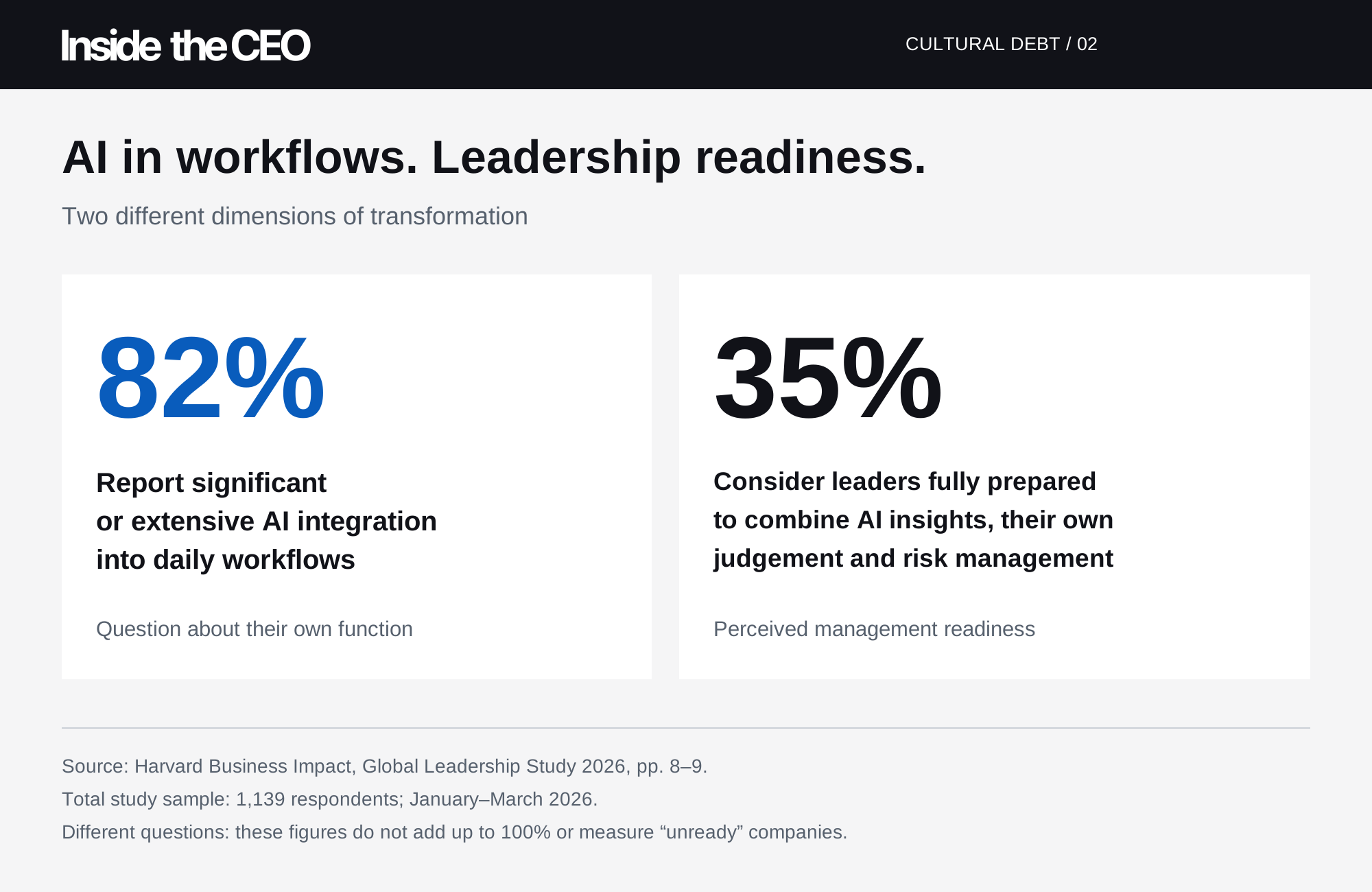
The Global Leadership Study 2026 reveals how far AI use has advanced compared with perceptions of management readiness. 82% of respondents reported significant or extensive integration of AI into daily workflows; the question concerned their own function. Meanwhile, only 35% consider leaders fully prepared to combine AI-driven insights, their own judgement and the management of associated risks.
These are responses to different questions, so they cannot be used to calculate the share of companies that have introduced AI without appropriate management.
In a culture where a leader must always appear confident, AI can become a convenient source of convincing answers. In a culture where disagreement is unwelcome, quickly prepared analysis risks ending the discussion before its assumptions have been tested.
Practical protection starts with simple questions. What assumptions underpin this conclusion? What evidence is missing? Who might disagree? If a leader asks these questions only of junior colleagues’ work, but never of their own recommendations, the new technology leaves the old hierarchy intact.
There is another signal: only 31% of respondents said their organisation had made addressing employees’ concerns, trust and the challenges of learning to use AI a priority for the following year. This does not mean that everyone else ignores people altogether. It indicates where these issues sit among stated priorities.
Where a CEO can spot cultural debt
A useful starting point is a specific decision that has stalled. Who had the authority to make it? Why was it escalated? What reaction did the manager expect? The answers help distinguish a lack of knowledge from a situation in which someone knows what to do but the system encourages them to wait.
Another indicator is the journey of bad news. When did the team first learn about the problem, and when did the CEO hear about it? What happened to the person who raised it? If early escalation creates more trouble than a late excuse, the company is effectively teaching people to hide risks. Calls for transparency will achieve little without a change in the leader’s response.
Recent promotions and bonuses also deserve a review. What behaviour did they make attractive? Do leaders who develop their team’s autonomy gain an advantage, or do those without whom nothing works?
These questions are useful because they move the discussion of values towards observable decisions, consequences and incentives.
How to start paying down the debt
The first step is to choose one contradiction that already has a visible cost. For example, the company demands speed, but a routine customer decision passes through several approval levels. Describe the delay, its cause and the risk that each approval is meant to guard against.
The second step is to change the rule within a limited area. A team can be given authority to decide a particular class of issues independently within a budget, with clear escalation conditions. A pilot will test whether decision times fall without an increase in errors or complaints.
The third step is to align assessment with the new expectations. If a manager is expected to experiment, define the acceptable risk and how the outcome will be assessed in advance. It helps to distinguish a diligent test of a hypothesis that was not confirmed from careless execution. Otherwise, the right to make mistakes remains a promise with no practical meaning.
The fourth step concerns the CEO’s behaviour. Publicly revising a decision after a well-reasoned challenge shows the team that discussion really is possible. A calm response to an early report of a problem makes transparency less risky.
AI projects add a separate responsibility: defining who checks recommendations and which professional skills the team must retain. Automation reduces some of the work, but it can also reduce the practice through which people learn to recognise mistakes. The report’s authors stress the need to keep reasoning, discussion of alternatives and accountability for choices visible.
Findings from the Global Leadership Study
The Global Leadership Study draws on 1,139 responses and additional interviews collected in 2026. Half the sample consists of functional leaders, and half of HR and learning and development professionals. 49% of respondents work at companies with revenue above $10 billion, and 46% at companies with at least 20,000 employees. It is primarily a large-business perspective.
The survey describes perceptions and priorities; it does not establish a causal link between a specific cultural practice and profit. Yet it gives CEOs a strong reason to revisit the familiar diagnosis that “the team lacks skills”. Before commissioning training, ask what will happen to an employee who starts applying the new knowledge tomorrow. If they stand to lose influence, a bonus or their manager’s support, the company’s rules also need to change.
Sources
Harvard Business Impact. No Stable Ground: Global Leadership Study 2026. The figures of 41% and 29% appear on page 12, citing a separate study, Transformation That Endures.